Blogham

Fruit of the Vine

So here I am playing ‘catch up’ again after being away visiting family in my home island of Jersey, C.I. … 🇯🇪🌞 I took plenty of tree photos whilst I was there which can be seen here on my Facebook page 🙂📷🌳🌲🌴

‘Vine time’, according to Grave’s calendar, started on the 2nd September ..

Most of September is dedicated to Muinn the Vine on the ‘Celtic Tree Calendar’ but sometimes you will see Bramble in place of Vine for Muinn – this is because it is it is considered to be the closest equivalent for those living in the more northerly climes 😉

Also grape vines were not introduced to Britain until the Romans arrived and the climate was a lot warmer than it is now.  Vineyards flourished in much of Britain right up until the second part of the 16th Century when temperatures began to drop again. 

You can still see the descendants of original Roman vines growing at The Roman Palace of Fishbourne in West Sussex and the wine Wrotham Pinot is made from this variety of grape.

Vine is the only cultivated ‘tree’ of the Ogham and being an introduced species had to be treated with meticulous care in order for it to survive and produce enough fruit. 

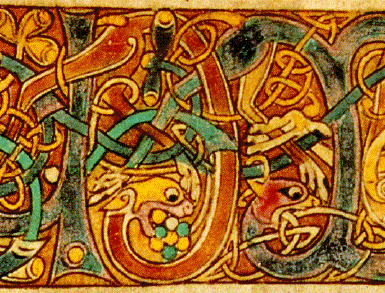
In Celtic art you will often see the ‘spiralling vine’ – no doubt a symbol for them of evolutionary growth, expanding awareness and connection with the Divine.

Lions and Intertwining Vines in the Book of Kells

Of course getting merry on the wine produced would also have been regarded as a route to ‘Divine inspiration’ but as we all know exhilaration can so easily be lost when we over indulge so the Vine also encourages “all things in moderation” 😋🍷  

Muinn also symbolises completion of work and its rewards .. so in effect ‘harvesting’ which is very appropriate for this time of year.  

September’s full moon is known as the Harvest Moon (the full moon closest to the Autumnal Equinox) and this year it  falls on Tuesday 21st at 00:55hrs  so why not celebrate by treating yourself to a nice juicy bunch of grapes!🍇😜  … well we do have to be sensible now don’t we! 😉 

Have a Great (rest of) September!

Kim  x

La Mare Wine Estates ~ Jersey, C.I.

Nuts for Knowledge!

Today we come into the ‘month’ of Hazel according to the Robert Graves’ ‘tree calendar’ .. 🌜🌳

You may already be familiar with the ancient Irish Celtic myth about the ‘Salmon of Knowledge’ – the magic fish who lived in the otherworldly ‘Well of Wisdom’.  Nine hazel trees were said to have grown around the well, from which dropped nine hazelnuts – the Salmon eagerly gobbled them up and thus gained all the knowledge of the World ..only to then became the brain food for Fionn mac Cumhaill!  🌰🌰🌰🌰🌰🌰🌰🌰🌰🐟 …..😋

Well it was actually supposed to be for his teacher Finn Eces – if only he’d done his own cooking! 🤭

You can read the whole story here ..

Ask About Ireland ~ The Salmon of Knowledge

River Boyne, Ireland

Interestingly a search on the net for the ‘top 10 brain foods’ will show you that oily fish such as (wild) salmon near enough tops the list every time  ..with nuts of all kinds not much further behind – this due to the essential fatty acids such as Omega 3 contained in these foods 🌞

Hazel trees often grow near water and water is associated with ‘intuitive knowledge’ which probably explains why hazel wood is a favourite choice for dowsing rods 🍃

The number 9 in numerology symbolises (among other things) ‘universal understanding’ and is considered to be a sacred and magical number in many ancient and modern traditions ✨

 Here is a website which gives an extensive insight into the number 9 ..

Library of Halexandria ~ Nines

… so definitely some food for thought there! 🧐

Most of us get our hazelnuts via (not so healthy) biscuits, cakes and chocolates – praline being a particular favourite .. just thinking of that big green triangle 😋   Otherwise Christmas is probably the only time that some of us will eat them in their raw form .. when the walnuts, brazils and almonds have gone 😌 ..

Christmas is still a long way off but with my Swiss Father-in-Law celebrating his 90th birthday next week I thought it would be nice to make mention of this traditional Swiss cake which originates in his home canton of Berne 🇨🇭🎂🎉

It’s called ‘Haselnusslebkuchen’ which literally means ‘hazelnut ginger cake’ though cinnamon rather than ginger seems to be used in the recipe.  You may be wondering why a bear on top of a Christmas cake? 🐻  Well that is because he is Berne’s heraldic animal, its mascot and possible namesake, though Santa Claus is sometimes piped in his place 🧑🏼‍🎄

You can read all about this world famous product here on Wikipedia – I’ll try to obtain a recipe for it to post on site for you just before Christmas, in the meantime enjoy the rest of the summer Folks!

🌞🌳💕

Kim x

Holly in July?

I am playing ‘catch up’ here after what, (I am very sorry to say), has been well over a month of inactivity on Divine Ogham – due to illness, work and being away 😮‍💨 I had hoped to post this on the 18th July for the old Celtic feast of Lughnasadh but I hope is better late than never! 😉

You may be wondering just how exactly the ‘Celtic Tree Calendar’ came about – as in how is each tree related to each lunar month? 🌘🤔🌳

Well it was Robert Graves who came up with the concept whilst studying the book ‘Ogygia’ written by the 17th century Irish historian Roderick O’Flaherty.  (The title ‘Ogygia’ was used as an allegory to ‘Ireland’ during the time of the Cromwellian confiscations and has no relation to ‘Ogham’). 

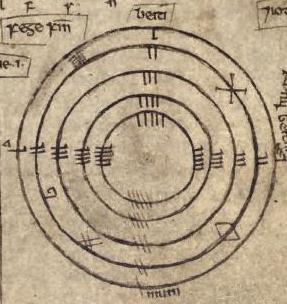
Within this weighty historical tome O’Flaherty had included a section on the ancient Irish alphabet – listing only 18 Ogham characters(13 consonants and 5 vowels) but attributing each of them to trees.🌲🍃

Graves almost immediately made a connection with the Celtic Lunar calendar  (with its 13 month cycle) and also with the 13 constellations of the Zodiac leading to his ‘invention’ of the ‘Celtic Tree Calendar’ as detailed in his famous book ‘The White Goddess’.

He was eventually able to incorporate all 20 Ogham characters by attributing them to the cardinal points, equinoxes and solstices – some with two trees! 🌳🌲

The order of the trees he based on classical myths, (which often have many similarities the world over),he also relied on ‘poetic intuition’ when interpreting such works as the ‘Cad Goddeu’ or ‘Battle of the Trees’, a medieval Welsh poem attributed to the bard Taliesin.

SO .. back to Holly in July! 😉

In Celtic mythology the ‘Holly King’ was said to rule over the dark half of the year with the ‘Oak King’ ruling over the light half.  These Kings were seen as twin aspects of the ‘Sun God’ with ‘Holly’ ruling from Midsummer until Yule, when the ‘Oak King’ would be reborn and eventually take power again.

Again you can read about these interpretations in ‘The White Goddess’ by Robert Graves and also in Sir James Frazer’s book ‘The Golden Bough’

Here is a really good website which tells you all about the Holly and Oak Kings and the various archetypes associated with them .. 

The Oak King and the Holly King

 http://www.earthwitchery.com/oak-holly.html

The Holly King 

http://www.earthwitchery.com/holly-king.html

So hoping that clarifies things! 😉

Here a photo of (variegated) Holly which I took in my Mother-in-Law’s garden in Jersey(C.I) during the height of Summer a few years ago 😊

Brightest Blessings!

Kim x

Happy Summer Solstice!

Well it is finally here .. the longest day of the year! 🌞 And living up here in Caithness, the northernmost part of Scotland – and indeed the UK – I will be experiencing almost 24hrs of sunlight, (if not actual sunshine).. well 18hrs and 23 minutes to be exact! 😉

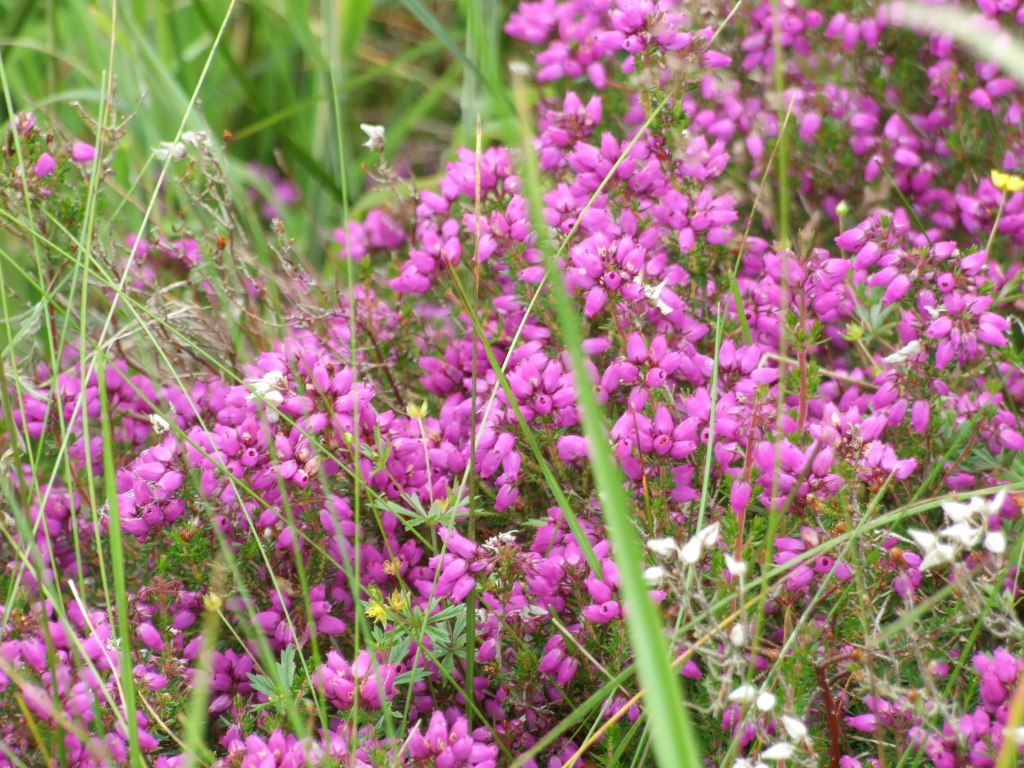
The Ogham ‘tree’ associated with this time of the year is the lovely Heather, or Ura as it is known in ancient Irish alphabet. This hardy little shrub starts coming into flower now in the northern hemisphere and was so associated with the old summer celebrations! 🌸

The flowers were, (and still are), used to make honey and beer and the flexible ‘twigs’ were used for thatching roofs and stuffing mattresses .. a ‘bed of heather’ often features in the most romantic Celtic myths! 💕

So Ura represents ‘love, passion and partnership’ .. with some ‘moderation’ called for .. lest you get ‘carried away with the fae’ 😉🧚

For LOTS more info about Heather in Scotland click here and below are some photos I took a few years ago out in the countryside of Caithness of two types of heather growing on the moors .. Common Heather or ‘Ling’ (Calluna vulgaris) and Bell Heather (Erica cinerea) ..

Wishing you all a Very Happy Solstice! 😊💕🌞 Xx

The Darling Buds of May

Today is the first day of ‘Hawthorn’ on our Ogham ‘Tree Calendar’ – ‘May’ being an alternative folk name for the Hawthorn.   The phrase was coined by William Shakespeare in his Sonnet 18 ..

‘Shall I compare thee to a summer’s day?
Thou art more lovely and more temperate:
Rough winds do shake the darling buds of May,
And summer’s lease hath all too short a date ..’


For the full poem along with a modern translation and analysis see  ..

http://www.shakespeare-online.com/sonnets/18detail.html

“Sonnet 18 is the best known and most well-loved of all 154 sonnets.”

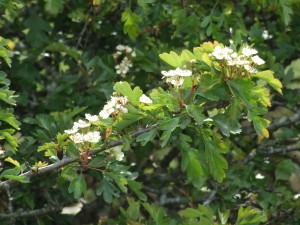
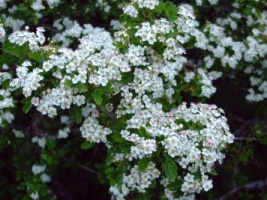
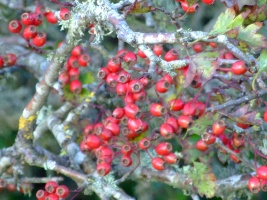
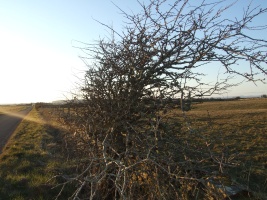
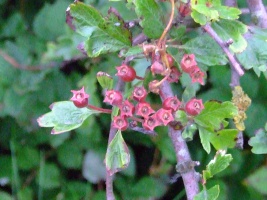
I think of the Hawthorn as a very feminine tree; the beautiful white blossoms, red berries in autumn and bare thorny branches in winter I see as the 3 stages of Womanhood – the blossoms the white lace of a wedding dress, the berries the ‘ripeness’ of pregnancy and motherhood, the thorns the prickly wisdom of an elderly lady – as with Maiden, Mother and Crone, the 3 aspects of the Goddess 🌒🌕🌘

When getting to know the trees whilst studying the Ogham this was my impression of the May ..

I really love the hedges which line a road nearby to where I live. The smell of the blossom and foliage in springtime, the pretty berries in autumn 🥰 They are wildlife corridors – on approaching them there are always birds to be seen flying in and out and they must give protection to a lot of small animals from the open fields. I think of them as a row of merry maidens – sturdy, strong country girls with pretty rosy cheeked faces who make you feel welcome and inspire confidence – kindly but knowing 😉 Because there is also something mysterious about them, you peer in but you still get a sense that there is more beyond what you can see – where do those birds and small animals really go? 🤔

There really is something quite mysterious about the Hawthorn, the ancient Celts saw this tree as a portal to the ‘Otherworld’ – a fairy tree that must never be cut down.  Even to this day in Ireland roads have been re-routed to avoid cutting down a May tree. 

Also several workers at John DeLorean’s car factory in Northern Ireland in 1982 blamed the failure of the company on the cutting down of an old Hawthorn tree during the factory’s construction!

Of course the most famous May tree of all has to be the ‘Glastonbury Thorn’ on Wearyall Hill near Glastonbury, Somerset.  Legend tells us that the original tree sprouted from the staff of Joseph of Arimathea after he thrust it into the ground on top of the hill whilst visiting the area – very similar to the story about St Patrick in Aspatria, Cumbria. Miraculously the staff burst into leaf and blossom as a sign perhaps that his mission to spread the Gospel in Britain would bear fruit.  It soon became a site of pilgrimage for early Christians until it was chopped down and burned during the English Civil War. A replacement tree was planted in 1951 but was sadly very badly vandalised again in 2010 – in March 2011 it was reported that a new shoot had appeared on the remaining stumps of the tree.💖

The ‘Glastonbury Thorn’ is a special variety of Hawthorn Crataegus monogyna‘Biflora’ which flowers twice a year – midwinter and May-time.  A spray from the Glastonbury Thorn is sent to the Queen each Christmas.

There is a real wealth of folklore to be found regarding May trees as any search for it on the internet will show you – here is some more particularly interesting information .. https://treesforlife.org.uk/into-the-forest/trees-plants-animals/trees/hawthorn/

‘It was at the dawn of day in the merry Maytime, when hedgerows are green and flowers bedeck the meadows; daisies pied and yellow cuckoo buds and fair primroses all along the briery hedges; when apple buds blossom and sweet birds sing, the lark at dawn of day, the throstle cock and cuckoo; when lads and lasses look upon each other with sweet thoughts; when busy housewives spread their linen to bleach upon the bright green grass.’

from The Merry Adventures of Robin Hood by Howard Pyle.

Wishing you all a very “Merry May!”

Kim x